Vizsla Information Sheet
What does glaucoma mean?
A diagnosis of glaucoma means elevated intraocular pressure. The normal value of intraocular pressure in dogs is 10–23 mmHg (millimetres of mercury). If the pressure is higher than this, we speak of glaucoma.
Why does intraocular pressure rise?
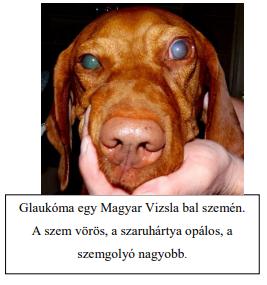
Intraocular pressure rises when drainage of the fluid circulating within the eye (the so-called aqueous humour) is obstructed. In certain breeds this occurs due to a congenital, or age-related, narrowing/closure of the drainage pathway (the so-called iridocorneal angle). This condition is called goniodysgenesis. When elevated intraocular pressure develops due to an abnormally developed iridocorneal angle, this is referred to as primary glaucoma.
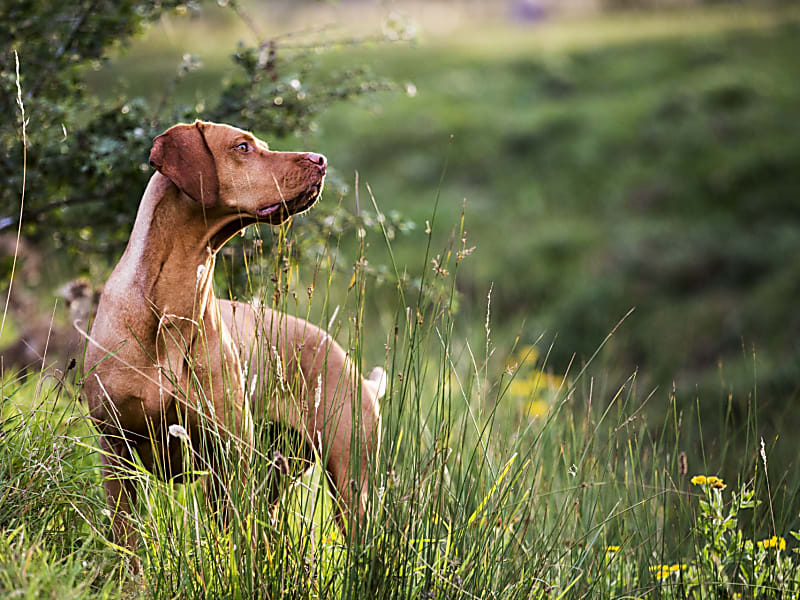
Since the aqueous humour produced within the eye cannot leave the eye, intraocular pressure rises, which later leads to blindness. Primary glaucoma usually appears around 3–7 years of age, and initially affects only one eye. Unfortunately, however, since the developmental abnormality is present in both eyes, the other eye also becomes affected weeks or months later. Numerous breeds are affected, including the Hungarian Vizsla.
What does goniodysgenesis mean, and how is it examined?
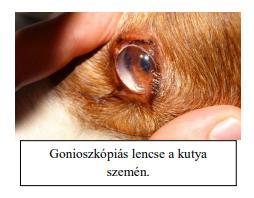
Goniodysgenesis refers to a developmental disorder of the iridocorneal angle and is examined by gonioscopy. During the examination, a magnifying lens is placed on the animal's eye, which magnifies the iridocorneal angle for the examiner, making it easier to assess. Before the examination the dog receives a local anaesthetic eye drop, so the examination causes no pain or discomfort.
What exactly does the veterinarian examine during gonioscopy?
During gonioscopy, we examine the width of the iridocorneal angle and the shape of the fibres located there (the pectinate ligament), and based on these we determine the severity of the abnormality.
My dog's iridocorneal angle is not perfect. What does this mean?
If the iridocorneal angle is only mildly abnormal, the dog in question will probably never have a problem with it. However, if this dog is mated with another individual that also has the abnormality, the abnormality may occur more frequently/severely in the puppies, meaning it is conceivable that they may later develop elevated intraocular pressure.
In addition, there are breeds (e.g. the Flat-Coated Retriever) in which the iridocorneal angle also changes with age, and glaucoma later develops as a result.
Why is this condition particularly important in the Hungarian Vizsla?
According to international research, primary glaucoma occurs frequently in the Hungarian Vizsla, but we do not yet know exactly why. We would like to examine a large number of individuals in order to assess how many Hungarian Vizslas have an abnormal iridocorneal angle, to what degree, and how this changes with age.
If the research is successful, we will be able to provide data specific to the breed, which is very important both from a prognostic and a breeding standpoint, since glaucoma is a painful disease that ultimately leads to blindness — something every owner and breeder wants to avoid.