Collie Eye Anomaly

What is CEA?
CEA is a congenital and hereditary eye disease that affects the posterior part of the eye, which is rich in blood vessels, connective tissue, and nerves (namely the sclera, the choroid, and the retina).
Which breeds does CEA affect?
It occurs primarily in Collies (both rough- and smooth-coated), but can also be found in Shelties, Australian Shepherds, Border Collies, and Lancashire Heelers.
What are the symptoms of CEA?
The clinical signs of CEA vary widely. Some dogs show no noticeable visual impairment, while others may be completely blind.
From an ophthalmological standpoint, four severity grades are distinguished.
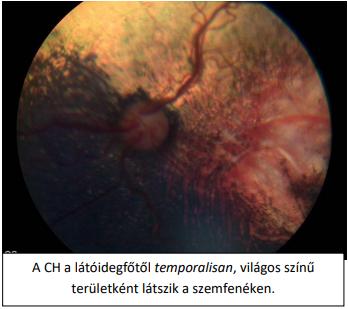
1. Choroidal Hypoplasia (CH)
The choroid lies beneath the retina and is responsible for nourishing it. Hypoplasia means the choroid has not developed properly. This is the most common finding. It always affects both eyes (though not necessarily symmetrically). Histologically, the neuroretina (the tissue responsible for vision) is only affected in cases of extensive CH, so this abnormality usually does not cause visual impairment. Since mild lesions can become pigmented over time, the first eye examination in affected breeds is recommended between 6–8 weeks of age.
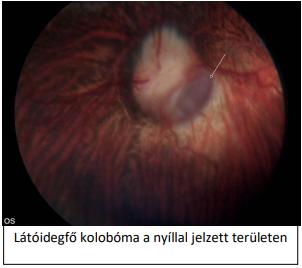
2. Coloboma
A coloboma means there is a tissue defect in a given area. In CEA, a coloboma can develop in the posterior part of the eye (at or around the optic disc). This abnormality does cause visual problems, since part of the nerve needed for vision is missing. Furthermore, continuing to breed these animals may produce even more severely affected offspring.
For this reason, a coloboma results in exclusion from breeding. With large colobomas, retinal detachment may occur over time.
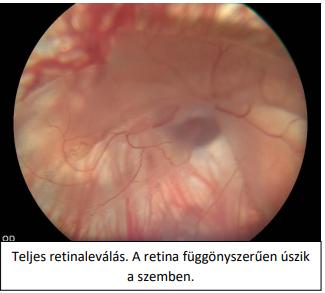
3. Retinal Detachment
Retinal detachment can be a consequence of the coloboma mentioned above; in severe cases, puppies may already be born with a detached retina, or the retina may detach at a few weeks of age. This happens because the retina does not properly attach to the layer beneath it.
The animal cannot see in the area of retinal detachment, and is blind if the entire retina is detached. Naturally, these animals must not be bred either.
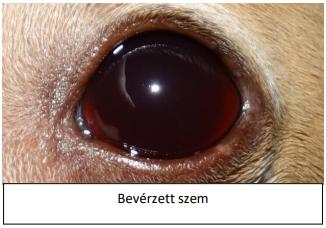
4. Intraocular Hemorrhage
In a small percentage of affected dogs, bleeding occurs within the eye, which can lead to further serious complications (e.g., elevated intraocular pressure).
As a breeder, how can I avoid producing affected puppies?
This requires ophthalmological and genetic screening of the breeding pair. In affected breeds, screening as a puppy between 6–8 weeks of age is strongly recommended, followed by another examination before mating.
Although dogs with CH generally show no visual impairment, breeding two dogs with extensive CH together could potentially produce more severe abnormalities, so it is advisable to consult a veterinary ophthalmologist about this condition as well.
As an owner, how can I avoid buying a sick puppy?
If you are buying a puppy of one of the affected breeds, ask for the results of its puppy eye examination. While no exact figures exist, roughly 90–95% of the Collie population in Hungary is affected by CH — the mildest form of CEA.
As mentioned earlier, this abnormality will not interfere with your dog's normal life, so if the only finding on the screening result is CH, you can safely purchase the puppy.
2. Coloboma
A coloboma means there is a tissue defect in a given area. In CEA, a coloboma can develop at the back of the eye (at or around the optic disc). This abnormality already causes vision problems, since part of the nerve needed for sight is missing. Moreover, if these animals are bred further, even more severely affected offspring may result.
For this reason, a coloboma means exclusion from breeding. With a large coloboma, retinal detachment may occur over time.
3. Retinal Detachment
Retinal detachment can be a consequence of the coloboma mentioned above; in severe cases, puppies are either born with an already detached retina, or the retina detaches within a few weeks of age. The cause is that the retina does not attach properly to the layer beneath it.
In the area of retinal detachment, the animal cannot see, and with complete retinal detachment it is blind. Naturally, these animals must not be bred either
4. Intraocular Hemorrhage
In a small percentage of affected dogs, bleeding occurs within the eye, which can lead to further serious complications (e.g., high intraocular pressure).
How can I avoid producing sick puppies as a breeder?
For this, ophthalmological and genetic screening of the breeding pair is necessary. In the affected breeds, screening in puppyhood between 6-8 weeks of age is definitely recommended, and then another examination is needed before mating as well.
Although dogs with CH generally do not show any visual impairment, it is conceivable that mating two dogs with large-area CH could result in a more severe abnormality, so for this condition too, you should seek the advice of a veterinarian specializing in ophthalmology.
How can I avoid buying a sick puppy as an owner?
If you are buying one of the affected breeds, ask for the results of the puppy's eye examination. Although there is no exact survey, roughly 90-95% of the Hungarian Rough Collie population is affected by CH, i.e., the mildest form of CEA.
As mentioned earlier, this abnormality will not hinder your dog's normal way of life, so if the screening result shows only this abnormality, you can safely buy the dog.