Cherry Eye
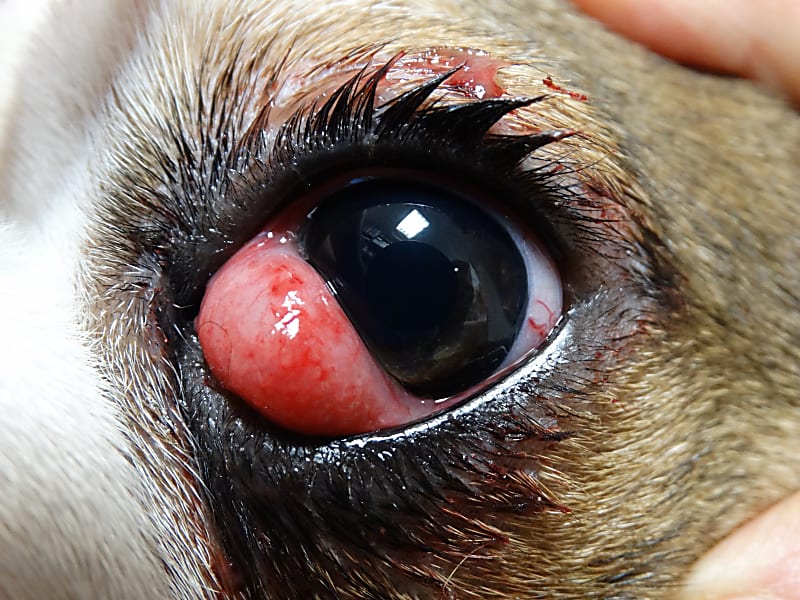
Where is the gland of the third eyelid located?
The third eyelid is a triangular fold of mucous membrane located between the eyeball and the lower eyelid, at the inner corner of the eye. Its job is to protect the eye. On its inner surface sits the gland of the third eyelid, which plays an important role in tear production.
What does the gland of the third eyelid do?
The gland of the third eyelid is responsible for roughly 30% of tear production. If the gland's function is reduced, so-called dry eye disease (keratoconjunctivitis sicca) can develop, which is a very painful condition.
How can I tell whether my dog's third eyelid gland has prolapsed?
Normally the third eyelid gland is not visible. In some dogs, the tissue that holds the gland in place can loosen during growth, allowing the gland to prolapse. The prolapsed gland becomes swollen and inflamed. A reddish-pink, rounded mass then appears in the inner corner of the eye (hence the English name for the condition: cherry eye).
The affected eye usually has discharge and waters. If the gland has been prolapsed for a longer period, its surface takes on a "raspberry-like" appearance (swelling of the lymphoid follicles) and dries out.
Prolapse of the third eyelid gland occurs primarily in young dogs, mainly in the following breeds:
- Brachycephalic breeds: Shih Tzu, Boxer, English Bulldog, Lhasa Apso.
- Large-bodied dogs with loose skin: Mastiff, Great Dane, Cane Corso.
Both eyes are often affected, though not necessarily at the same time.
How can my dog be treated, and how successful is the surgery?
Repositioning the third eyelid gland is done surgically, under general anaesthesia. The surgery is successful in 90–95% of cases. However, recurrence (re-prolapse) is more common in large breeds, in which case further surgery may be needed.
The longer the gland has been prolapsed, the greater the chance that it will prolapse again after surgery.
If it's going to happen in the other eye anyway, wouldn't it be better to wait and operate on both eyes at once?
Repositioning the gland is only possible once it has already prolapsed. This means that the other eye, where the gland has not yet prolapsed, cannot be operated on.
The affected eye, however, should be operated on as soon as possible, because a prolapsed gland cannot perform its function.